From Invoking Ireland, pp 69-74
We know him as St Ciarán of Saighir, one of Ireland’s earliest Christians. It is said that he met St Patrick in Rome. Sensing a kind of saintly outlandishness in him, Patrick gave him a hand-bell, telling him to go home and set up a monastery wherever it rang unrung. It rang, unrung, in a wilderness scarce in everything except savagery.
Reverent remembrance, already old in the eighth century, loves his story:
The blessed Ciarán took up his habitation like a hermit in the waste, for all about was a waste and tangled woodland. He began to build his little cell of mean stuff, and that was the beginning of his monastery. Afterwards a settlement grew up by God’s gift and the grace of the holy Ciarán. And all these have the one name, Seir.
Now when he came there he sat down under a tree in the shade of which was a boar of savage aspect. The boar seeing a man for the first time fled in terror, but afterwards, being tamed by God, it returned like a servant to the man of God. And that boar was Ciarán’s first disciple and served him like a monk in that place. For the boar immediately fell to before the eyes of the man of God and with his teeth stoutly severed branches and grasses to serve for the building of the cell. For there was none with the holy man of God in that place. For he had fled to the waste from his own disciples. Then came other animals from the lairs of the waste to the holy Ciaran, a fox, a badger, a wolf and a stag. And they abode with him as tame as could be. For they followed the commands of the holy man in all things like monks.
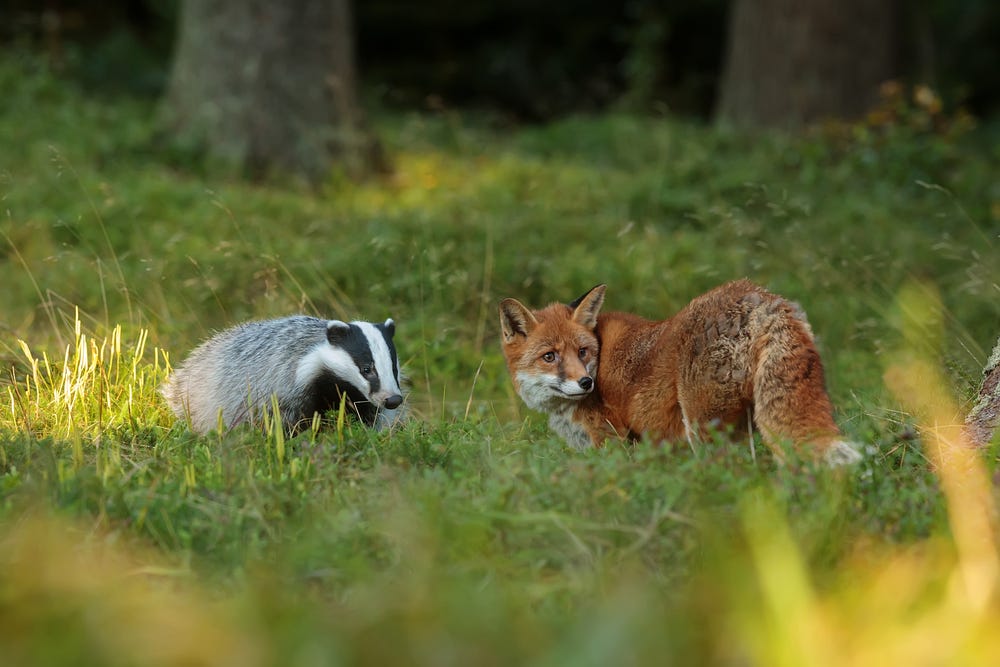
One day the fox, being more subtle and full of guile than the rest, stole the slippers of the abbot, the holy Ciarán, and turning false to his vow carried them off to his old earth in the waste, designing to devour them there. And when the holy Ciarán knew of this, he sent another monk or disciple, the badger, to follow the fox into the waste and to bring his brother back to his obedience. So the badger, who knew the ways of the woods, immediately obeyed the command of his elder and went straight to the earth of Brother Fox. He found him intent on eating his lord’s slippers, so he bit off his ears and his brush and tore out his hairs. And then he constrained him to accompany him to his monastery that there he might do penance for his theft. So the fox, yielding to force, came back with the badger to his own cell to the holy Ciarán, bringing the slippers still uneaten. And the holy man said to the fox: “Wherefore, brother, hast thou done this evil thing, unworthy of a monk? Behold! Our water is sweet and common to all. And if thou hadst a desire of thy natural craving to eat flesh, the omnipotent God would have made thee flesh of the bark of trees at our prayer.” Then the fox, craving forgiveness, did penance fasting, and ate nothing until the holy man commanded. Then he abode with the rest in familiar converse.
Afterwards his own disciples and many others from every side gathered about the holy Ciarán in that place; and there a famous monastery was begun. But the tame creatures aforesaid abode there all his life, for the holy elder had pleasure to see them.
What a charming end to our battle with the Beast in ourselves and in the world! Ciarán and badger and boar and fox and stag and wolf singing matins together in a little thatched church in the wilderness, its door antler high and wide to nature inside and outside us:
Caeli enarrant gloriam Dei, et opera manuum ejus annuntiat firmamentum.
Singing lauds together:
Cantate Domino canticum novum, cantate Domino omnis terra. Cantate Domino, et benedicite nomini ejus: annunciate de die in diem salutare ejus. Annunciate inter gentes gloriam ejus, in omnibus popules mirabilia ejus...
Singing nones together:
Jubilate Deo omnis terra: servite Domino in laetitia. Introite in conspectu ejus, in exultatione.
Singing vespers together:
In ilia die stillabunt montes dulcedinem et colles fluent lac et mel, alleluia, Euouae.
It must be that Ciarán was at ease with animal nature in himself, else the boar-brutal, fox-vicious, stag-shy animals of the wilderness wouldn’t have been so happy to sing Nunc Dimittis, bringing compline to an end, with him:
Nunc dimittis servum tuum, Domine, secundum verbum tuum in pace, quia viderunt oculi mei salutare tuum, quod parasti ante faciem omnium populorum, lumen ad revelationem gentium et gloriam plebis tuae, Israel.
Bethlehem and Saighir or, as it is phonetically rendered in the text, Seir.
Over the centuries, Christians have become used to Bethlehem, to the idea of two domesticated animals, an ox and an ass, breathing warmth on a wonder-child lying in their manger.
But what of Seir? What of two savage animals, a wolf and a boar, what of them singing matins? What of them, before they go back to their monastic cells at night, singing Simeon’s Song of Salvation:
Lord, now lettest thou thy servant depart in peace, according to thy word: For mine eyes have seen thy salvation, Which thou hast prepared before the face of all people; A light to lighten the Gentiles, and the glory of thy people Israel.
A wolf! With predatory eyes! Breaking off from the hunt and seeing salvation — with those eyes?
Is this the messianic outcome of history and of creation as the Bible foresees it?
Is it that, here in Seir, Ciarán and the animals are already living that outcome?
The wolf also shall dwell with the lamb...
The lion shall eat straw like the ox.
The sucking child shall play on the hole of the asp and the weaned child shall put his hand in the cockatrice’s den.
There will be no hurt on God’s holy mountain.
A sense I have is that there is something quite different going on in Seir.
The sense I have of him is that Ciarán is a Christian Orpheus.
In his nature, in all of it, not just in part of it, he has emerged into the Orphic note and that is why the animals, savage like the boar and shy like the stag, are happy to sing it with him.
Not that it is all Orphic plain sailing in Seir.
When it does eventually happen, the regression, while comic, is serious, especially so in the case of the badger.
One day there it was, another bowl of vegetable soup set before the fox. Looking down into it, his mouth wearied and watered for flesh, for bleeding, hot raw flesh deep as his teeth. In his mind he had a hare in sight, his nostrils drinking her smell. Mightily he resisted the impulse and soon again he was calm, the soup, as it so often did, tasting like penance. Next day, passing his cell door, he saw that the abbot had left his slippers outside to dry in the sun. Thinking that he might find the taste of hide in the leather, he yielded to his instincts and made off with them and before he knew what was what he was back to his old ways in his old earth in the wood.
No sooner had the badger entered the earth than he too regressed, turning snarlingly savage, biting off the fox’s ears, biting off his tail, tearing the fur from shoulder and belly. Never, during all those years in the wild, had he fought as ferociously as he did now, in the interest, seemingly, of monastic law and order.
So what then of the Orphic note? Does it exist? And if it does, are there people who in their very being become it? Is it immanent in all of nature, in rocks, in animals, in stars? Is the universe but a blossoming of it? Is it an astronomical exuberance of it? Is it the eternal divine silence in its adventure into sound that we are talking about? Is that what the Orphic note is, the sound of the eternal divine silence, that sound solid in rocks, stellar in stars? And when someone reverts from sound to silence, will wolf and badger and boar and fox and stag, as by impulsion from an awakened instinct that lessens established instincts, will they turn on their trails, following what is now their chief desire, to be sym-phonic with it?
To be symphonic with it in Ciarán of Seir is to be symphonic with it in themselves. In Seir, to be symphonic with it as sound is to be symphonic with it as silence. The boar and the stag who were symphonic with it as sound at matins, at lauds, at nones, at vespers and at compline, were symphonic and maybe homeophonic with it as the eternal divine silence.
It should be remembered as a great day — the day a handbell rang unrung in Ireland.
And Seir? Seir is the bindu, the centre of the mandala, the place of universal emergence and return.
And Ciarán? As Ogma once was, Ciarán is now the philosophical question. To understand him is ultimate understanding of all things.
In Ireland, St Ciarán’s Christianity preceded the Christianity of St Patrick. Isn’t it time we gave it precedence in other than a temporal sense? In this of course, even in thinking about it, we must remember that it was Patrick who gave the hand-bell to Ciarán, and so, in fairness, the question of precedence must remain undecided. What is important is that, having been a founding bell, the hand-bell could be the bell of refounding.
Christianity isn’t only a morality that has its source in divine command.
As well as so much else that it presumably was, at Seir Christianity was the lived apprehension of unity in plurality out of which an ecumenical morality prospered. Ecumenical not just among human beings of different persuasions and languages. Ecumenical across all boundaries, among all species living and extinct, among all worlds visible and invisible.
And as for what happened to Brother Fox and Brother Badger, well, yes, it happens to individuals, it happens to tribes, it happens to civilizations and we only have to look at the one we live in to know that it happens to worlds.
As Christ born on the bestial floor does, as Christ in the Canyon does, Ciarán of Saighir suits our world.


Thanks for this wonderful read, Loup.
"No sooner had the badger entered the earth than he too regressed, turning snarlingly savage, biting off the fox’s ears, biting off his tail, tearing the fur from shoulder and belly. Never, during all those years in the wild, had he fought as ferociously as he did now, in the interest, seemingly, of monastic law and order."
This is an extremely thought provoking piece, and this part specifically made me pause. The idea that the badger fought even more savagely for law and order than it had in the wild has implications in our human life as well. I loved reading this, as always!