Earth, Sun, and Stars As Symbols
It is said: “In the beginning God created heaven and earth.” By “heaven” is understood the realm of spiritual realities, invisible and bodiless. By “earth” is understood the ensemble of symbols of those realities, perceptible and bodily. The earth is therefore a symbolic image of heaven.
All physical forces in the earth — such as attraction and repulsion, heat, electricity, radiation, and the rest — are symbols of spiritual powers in the heavenly kingdom. In themselves these forces would neither be forces nor even be able to exist if there were not behind them incomparably greater, original, spiritual powers. And if above the physical forces there were no might and control of rational, eternal powers, they would grow feeble, fall into confusion, and turn the whole world into chaos. As it is written of God and His creatures: “When Thou turnest away Thy face, they shall be troubled. Thou wilt take their spirit, and they shall cease; and unto their dust shall they return” (Psalm 103).
The sun is a symbol of God Himself. Saint Gregory the Theologian writes: “What the sun is for the senses, God is for the spirit.” Just as the sun shines and by its light illumines and warms all living beings on earth, so God illumines all souls with His mind and warms them with His love. Without the sun — death to bodies; without God — death to souls. Moses said to the people of Israel: “See, I have set before you life and death… therefore choose life, that you may live” (Deut. 30:19). That is: know God, the one living and unseen God, and worship Him alone; and do not worship visible symbols as gods, lest you become an idolater. The former is life; the latter, death.
“For the Lord God is a sun and a shield” to the righteous, says the God-inspired prophet (Ps. 84:11). (This expression does not appear in all translations.) Of course, the prophet has in mind God as the eternal light, the eternal luminary of truth, righteousness, and love. The prophet Malachi calls God the “Sun of righteousness” (Mal. 4:2; 2 Pet. 1:19). The seer John relates in his Revelation how he saw the city of the heavenly King, the Jerusalem on high, and says: “And the city has no need of the sun or of the moon to shine in it, for the glory of God illumines it.” And elsewhere, describing the glory of the righteous, he says: “And there shall be no night there; and they have no need of lamp-light nor of sunlight, for the Lord God will illumine them” (Rev. 21:23; 22:5).
But someone may object: did not Christ call all the righteous “suns,” and is not the sun therefore a symbol of all the righteous? Truly the Lord said: “Then the righteous will shine like the sun in the kingdom of their Father” (St Matt. 13:43) — and more strongly and beautifully than this visible, physical sun. That is, they will shine in likeness to God, the Sun of righteousness. But the light with which they will be clothed and shine will not be from themselves but from God, just as the stars have their light from the sun. Of this the Apostle Paul speaks clearly: “One glory is of the sun, and another glory of the moon, and another glory of the stars” (1 Cor. 15:41).
The prophet Daniel says of the righteous that they “shall shine like the stars forever and ever” (Dan. 12:3). And Symeon Metaphrastes likens the saints to stars which, set in the firmament of heaven, illumine the whole universe. Many other great spiritual writers have always regarded the stars as symbols of angels, of the righteous, and of God’s friends, while they regarded the sun as the symbol of the King Himself and God Most High.
Thus we Christians understand the earth, the sun, and the stars as symbols of spiritual reality, and by no means as reality itself. The pagans, ancient and modern, have looked and still look upon these cosmic bodies as reality itself. Reality — and immediately worship! Hence pagans of every age fell into the dark delusion of worshiping those creatures of the Creator as deities. The Greeks worshiped the earth under the name Ge, and the sun under the name Apollo. In Egypt the sun-god was called Osiris and the moon Isis. The moon was especially worshiped in Babylon, Assyria, and Arabia under the name Astarte. The Persians, worshipers of fire, bowed down to the stars as deities.
The delusion of idolaters, ancient and modern, arose from this: it was not their spirit that led their eyes, but the reverse — the eyes led the spirit. The spirit, like a blind man, stumbled after the sensory sight and bowed down to what the eyes proclaimed to it as reality, as divinity. The Savior had to come to strengthen the enfeebled spirit and give it precedence over the eyes and over matter. And the Savior did come among men and proclaimed the eternal truth: “God is Spirit” (St John 4:24). For those who heard and received this, the scales fell from their spiritual sight — as from the blinded Saul — and they suddenly began to see and behold. They saw and understood that all the things in the world which they had hitherto worshiped as gods, as truth and reality, were nothing other than parables about the one, eternal, living God.
The Knowledge of Truth
Since God is Spirit, all truth must be spiritual. For God and truth are one and the same.
When we speak of sensible objects, of their properties and relations, and then say: “this or that is true,” we do not mean truth in the absolute and eternal sense, but in a relative and practical sense. For in the absolute sense, only God is the eternal and inviolable Truth.
Does this mean that created nature is a lie? God forbid! But it can present itself as a lie to two types of people: to the European materialist and to the Indian nihilist. (There are two kinds of nihilists: political and philosophical. Here the philosophical nihilist is meant.) When the materialist says: “This nature which we see and perceive, with the whole sum of its perceptible properties and actions, constitutes in and of itself the whole truth, the whole reality — everything that can exist at all,” then nature truly appears as a lie. Likewise nature appears as a lie, through and through, to the spirit of the nihilist when he confesses and says: “This nature, with all its properties and actions, is a deception, a dream, a nothing.”
Thus both he who asserts that the sensible nature is sheer truth, and he who says that sensible nature is a lie, a dream, and an illusion — both utter an equal untruth.
Nature is a symbol of truth. The physical world is the visible expression of the invisible spiritual world. The first is the symbol; the second is the meaning of the symbol — spirit and reality.
When the Christian poet, Saint John of Damascus, says: “Truly, all is vanity;
life is a shadow and a dream,” he does not think in the least as a Buddhist nihilist. He looks with visionary spirit toward the real and eternal life, in comparison with which bodily life on earth is indeed like shadow and dream. He calls “vanity” everything that unspiritual people pursue in this world in search of truth and happiness. The world in itself is not a deception, for its Creator is the true God. From the fountain of truth how could a lie flow, when the fountain itself is truth? But the world can appear deceptive to one who seeks in it what it neither has nor is — like trying to catch the moon in the water.


John Three Sixteen
"Cosmic ♥️ Agape"
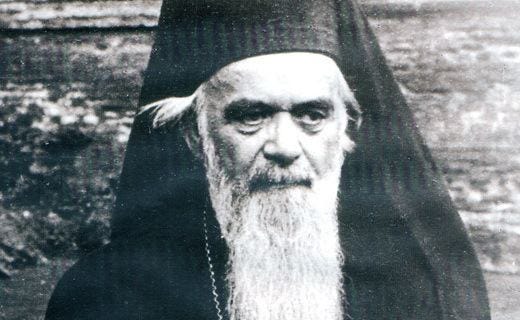
Saint Nikolai Velimirovic is, for me, one of the most important persons 📚✍🏼 I have ever come across. God is wonderful in His Saints! ⚜️ 🌐🕯️📿
🔥 Matter matters loved ones, the Logos became InCarne.🩸 Holy Icons reveal Grace, holy symbols enhance and clarify faith. Like our Lord's instruction to the woman at the well, "God is Spirit, and those who worship Him must worship in spirit and truth." 🧲 Polarity without Duality, ⚡both / and. 🌌 Sun, moon and stars ~ faith, hope and love. Grace and peace to you.☀️