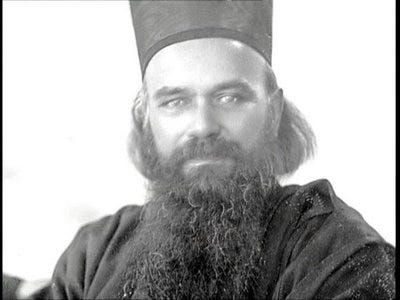
Reality and Its Symbols
While a child is learning the alphabet, letters themselves are for him a kind of idol. Letters are, for him, material reality. As he spells, the child fixes all his attention on the letters and with all his mind thinks only of the letters. When he reads a word, letter by letter, you ask him what he has read, and he does not know. And he is puzzled why you are asking him that. He has no inkling of the meaning of the letters he has read. The shape, size, and color of the written letters—this alone has made an impression on his soul; and this is all he currently knows about letters. Letters are for him material reality, just as idols are for an idolater. Hence both the primer-pupil and the idolater look upon their idols with fear and reverence.
Many adults are similar to primer-pupils, and even many who call themselves philosophers and scientists. With great labor and sweat they barely attain to spelling out the letters of nature, but never to their sense and meaning. A literate person reads letters without thinking about the letters; he reads catching quickly their meaning. A teacher must toil long to teach a pupil to “read for meaning.” What holds true regarding a book holds true regarding nature as well. Worshipers of nature are the same as worshipers of letters. Worshipers of nature are adults, but undergrown children. If you ask them what things and events signify, they look at you just as puzzled as a primer-pupil asked about the meaning of what he has read.
Thus one may say: all idol-worshipers are illiterate, and only worshipers of the Spirit are literate. For the former, created things in nature represent a material reality, expressed in their forms, sizes, colors, and various functions and relations. For the latter, creatures are symbols, and spiritual reality is the meaning, the life, and the justification for the existence of those symbols.
Saint Symeon the New Theologian speaks wonderfully about this: “He who is enlightened by the Holy Spirit, who makes all things new, acquires new eyes and new ears, and no longer looks simply as a man, that is, sensibly at the sensible, but as standing above man he contemplates sensible and bodily things spiritually, as symbols of invisible things” (Symeon the New Theologian, Discourse 65). Such a one is indeed spiritually literate. He does not spell out the letters of nature like a beginner in literacy, like a primer-pupil, but goes after the meaning, grasps the meaning, and explains the meaning.
Saint Maximus the Confessor expresses himself similarly, saying: “The whole intelligible (spiritual) world is presented mystically in symbolic images in the sensible world for those who have eyes to see; and the whole sensible world is contained in the intelligible world.” (Maximus the Confessor, Mystagogy, ch. 2). This is seen by those who have eyes to see — that is, who are literate and know how to read for meaning; in other words, whose spiritual sight is opened so that they can behold spiritually by the spirit, and not only bodily with bodily eyes.
The Apostle Paul speaks of this in these words: “The letter kills, but the Spirit gives life” (2 Cor. 3:6). And again: “Now we see through a glass, in a riddle, but then face to face” (1 Cor. 13:12). And again, yet more expressly: “We look not at the things which are seen, but at the things which are not seen; for the things which are seen are for a time, but the things which are not seen are eternal” (2 Cor. 4:18).
From this it is clear that whoever reads nature without the Spirit and without meaning is reading death, seeing death, receiving death. And whoever regards visible nature as material reality and not as a riddle in the mirror of the spirit sees no more than the primer-pupil who has not advanced beyond spelling letters. And whoever looks at what is seen by the eyes as something eternal — as some philosophers did, from the ancient Greek naturalists down to their most recent Teutonic-Latin like-minded followers — is truly an illiterate idol-worshiper whose entire knowledge lies in spelling out and adoring senseless letters. Eternity belongs to spiritual reality, and to time belong the symbols of that reality.
The Old-Testament tabernacle, which the God-wise craftsman Bezalel made according to the pattern God showed Moses on Sinai, served “as a copy and shadow of the heavenly things” (Heb. 8:5). But the tabernacle vanished with the coming of Christ, just as letters pass from view when their meaning is understood. When reality appeared, the symbol of that reality disappeared. When the Lord came, He extended the symbolism of spiritual reality to the whole universe. Not only the tabernacle, which served, but the whole universe represents the copy and shadow of heavenly things.
Christ, so to speak, took up the symbols of nature with both hands to explain the spiritual reality He was revealing to the world. When multitudes gathered around Him, He told them many things in parables. The Slavic word “priča,” or the Greek “parabole,” denotes some dramatic action, or an ordinary event, or the relation of things to a person, but in such a way that it indeed has an evident sensible meaning, while its true and primary meaning is found only in the realm of spiritual realities — in the spiritual kingdom. “Therefore I speak to them in parables,” said the Lord, “because seeing they do not see, and hearing they do not hear, nor do they understand.” Why so? “For the heart of this people has grown dull” (Matt. 13:11–15). A “fattened” (dull) heart signifies the closing and blinding of the spiritual sight that is in the heart. And that spiritual sight, which is in the heart, embraces all that scholars vaguely call the subconscious, intuition, etc.—and more besides.
“To you it has been given to know the mysteries of the kingdom of heaven, but to them it has not been given.” Thus Christ spoke to His closer disciples. By whom was it given to them? By Him Himself. He removed from their hearts the dark accretions, and their spiritual sight was opened so that they could behold spiritual realities directly — like Adam before the fall — without parables and symbols. For sinless Adam in Paradise was perfectly literate in reading the sense and meaning of all created beings and things. Because of this Adam was able to give to every creature a name that corresponded to the spiritual essence or meaning that the creature symbolically represented. For the Creator did not name the animals, but brought them to Adam to see what he would call each one. And Adam did not err but rightly gave a name to every beast and to every bird of the air and to every animal of the field (Gen. 2:19–25).
To materialistic thinkers — men of dulled hearts — that seems a trifling matter: giving names to animals. Of course, it is quite a small and insignificant thing if one assumes that Adam gave names to the animals casually and senselessly, the way materialists now give names to their horses and dogs—more mock-naming than naming. But Adam did not do this casually and senselessly; he did it with a deep and accurate vision of the spiritual reality that the particular animals represented. That work, infinitely difficult for a sinner, Adam accomplished both quickly and easily. He easily read all the symbols of reality because it had been given him to know realities even without symbols—to see them with a crystal-clear heart in the Creator and through the Creator. This visionary knowing, this penetration and realization, the Savior renewed in His intimate disciples. He renewed it, but not quickly and all at once; rather slowly and gradually—through long instruction and purification, and finally by enlightenment from the Holy Spirit of God.
That beholding of reality without parables, without parabolai, which Adam had and lost and which the apostles, having lost, received again, is intended for all of us Christians. And we would all possess that marvelous Adamic and apostolic capacity—that sense for the immediate perception of truth—had we, after baptism, remained ungnawed and un-darkened by sin. But every sin turns our gaze down from heaven to earth and from the Creator to the abyss. After every sin we hide from God, just as Adam, having sinned, hid himself among the trees in Paradise (Gen. 3:8). And we hide and keep hiding, sinning and sinning, until at last external nature, our involuntary accomplice, becomes our god in place of God — that is, until truth completely vanishes from before our sight and the symbols of truth replace the whole truth, the whole reality. Or, in other words: until the sight of the heart becomes completely blind and we give ourselves over entirely to the animal sensory sight to lead us. And then it happens with us as it is said: the blind lead the blind.
Christ also said: “It is the Spirit that gives life; the flesh profits nothing” (John 6:63). Not only man’s flesh, but no flesh in the universe profits anything by itself. It can be of some use in this life only if the spirit employs it as its instrument, as its symbol. Spirit is reality; body is the symbol of spirit. The king is the king, and the royal arms are the royal arms. One would be irrational who denied the being of the king while acknowledging the royal arms as the king. Alas, such pitiable souls exist even in our Christian epoch, in our own days. It is as though we were living in the time of King Nebuchadnezzar so many thousands of days and nights before Christ, and not in the time of baptized kings twenty-five centuries after the idol-worshiper Nebuchadnezzar! But you, Christians, must not pay heed to the illiterate idolaters of our time, whether they wear a royal crown or an academic gown. You must be conscious that truth has been revealed to you, and that you know it. But — strive unceasingly, precisely, to know it.


Michelangelo and William Blake were right about God.
From a Biblical perspective the nature of God is seen as reflected in aspects of the created order. Yes, God to a certain degree does have the nature of space, wind, emptiness, mist, air, sky, force, energy, light, darkness so congenial to Buddhist/Hindu/New Age types. However humans as being made in the image of God, are the best representation of what God is like – especially a human at their highest development, a mature, wise, good, vital 50+ man or woman. I knew a dynamic, spiritual woman in her late sixties, another one in her eighties. They both reminded me of a female God the Father carrying personal authority.
To me saying God is NOT like a man – Our Father in Heaven - is dumbing God down, making God less than what he is, flattening the divine out, a less than human gas. In a true sense since humans are made in the divine image, humaness is intrinsic to God, God is even MORE human than we are, as our humanity is but an image of that which is being imaged. though divine humanity is an infinite multidimensional cube compared to our simple flat squares. God is even more perfectly human than us who are echoes, a flatter image of him.
There is much wisdom and truth in Michelangelo’s and William Blake’s depictions of God as a dynamic, active, wise older man. Far from being simplifications of God they point to his personal depth, his danger, his joy and love and perfect humanness and the familiarity and commonality we encounter when we meet him for he is like us for we are patterned after him. I realize and respect that in Orthodox Iconography depiction of the Father is frowned upon)
I had the blessing since earliest childhood of a deep immersion in the natural world including an agrarian upbringing in a beautiful part of the American Midwest and subsequently in beautiful parts of California. It has included what can be seen as animistic and esoteric experiences. The creation has been often deeply wonderful and life giving in a transient way but it didn’t give me something Jesus spoke of “but whoever drinks the water I give him will become in him a spring of water welling up to eternal life” A source of inner life available from God and not found in the creation.
In all this talk of a wild Christianity I see no talk of the wild spiritual life of Jesus had with God the Father. A wild life we can also have as being fellow sons of God filled with the Holy Spirit – John 1:12, Galatians 3:26, 4:6. A wild Christianity with the Father because it is empowered by the Holy Spirit doesn’t need nature immersion to happen, though having the privilege of nature immersion I suppose may be a useful adjunct for many. After all when Jesus gave prayer instructions in Matthew 6 he said to close the door to your room!, not to go forest bathing.
When you look at the actual spirituality espoused by Jesus and practiced by him in the Gospels it is utterly unfashionable by those who look to non-dual awareness, and “Christ Consciousness” "ground of being” as the ticket. No, nothing as ethereal as that! A Father in heaven, “pray to your Father who is there unseen”. Jesus was by no means ashamed of the old man and talked about and to him a whole lot. God speaking in an audible voice, expectation of specific even miraculous answers to prayer, lifting eyes in prayer, a robust intensely personal God the Father that isn’t you, but you can know, and directly know his love for you as an individual.
Jesus on the cross cried out “My God, my God why have you forsaken me” far from being a cry of abandonment it was act of teaching and prophetic proclamation – which was a part of his job at the time, it was a quote from the first line of Psalm 22 which contains prophecy of what was happening at the moment, and was a statement of deep faith and knowing.
I could go on and on with more examples from all over the Bible of this wonderful dualistic experience of the Living God. The Father made us as individual humans and intends to keep us that way. This is all very childlike as Jesus says we are to be. I know vigorous attempts have been made to squeeze this childlike knowing of the Father and the Biblical record into a new orthodoxy of a “wiser” quasi-Buddhism. The final state presented as the ultimate is us embodied as individual humans even as Jesus is now, in the presence of God, in a new physical creation of multiplicity, filled with the Holy Spirit, not generic vanilla pudding non-duality. Sounds like fun to me, which all children delight in.
By William Blake - we shall hear his voice.
Saying: come out from the grove my love & care,
And round my golden tent like lambs rejoice. . . . . . And round the tent of God like lambs we joy . . .
To lean in joy upon our Father’s knee.
......so yer say’n there's a chance!