

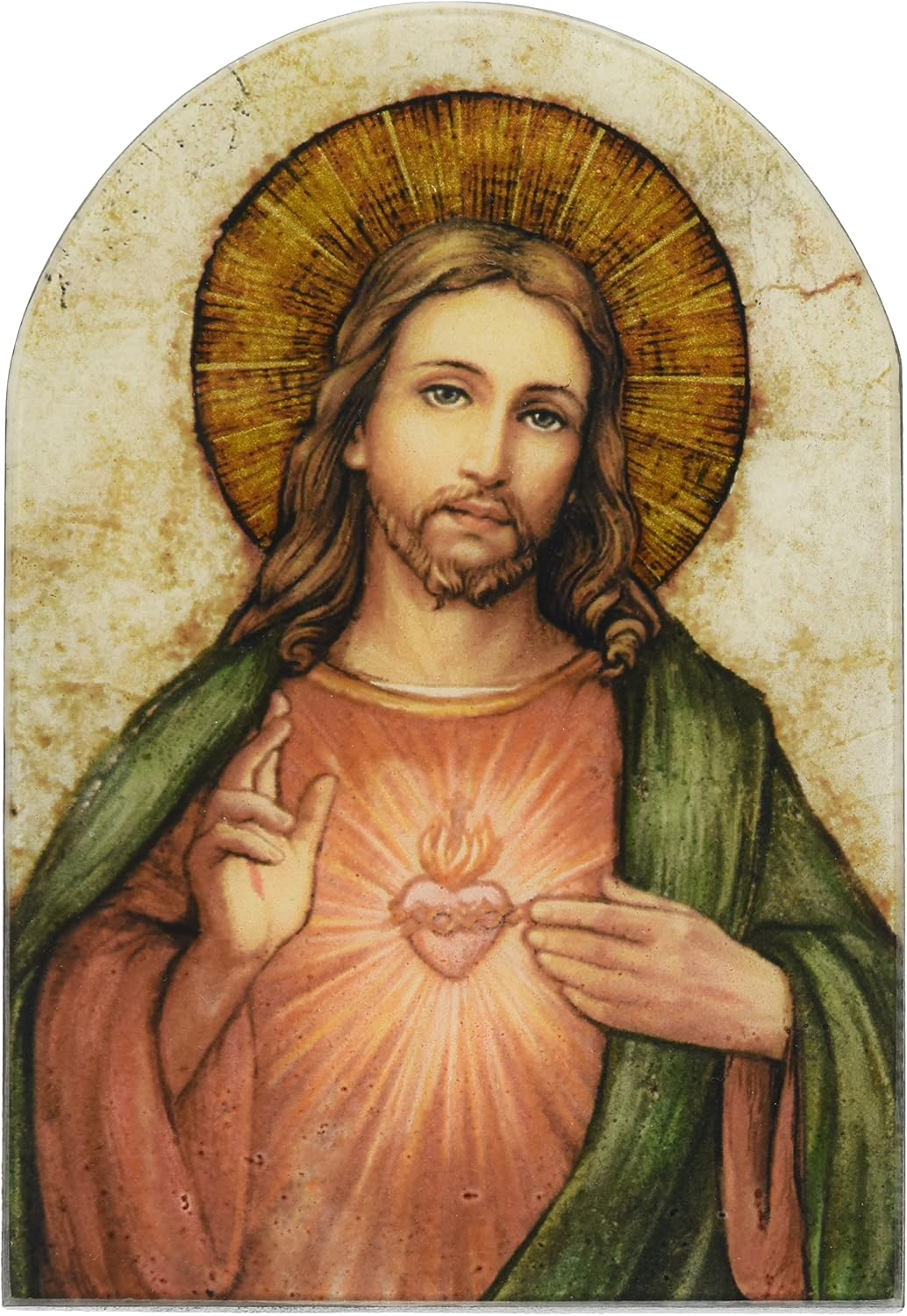
Jesus came to put his heart into humanity.
I was thinking this as I was wrestling again, as so often, with theodicy, with the problem of evil. Our little has cavities for reasons we can’t understand — good diet, good oral hygiene, but something else is going on, and at the coming appointment she’ll need novocaine, an initiation I’d devoutly wished I could spare her for a long time. We’re figuring it out — mouth breathing is my current suspicion — but it’s so painful to watch a child suffer.
I’m feeling so intensely the sorrow and weight of that pain. And that leads me to the reflection that essentially this is the pain, the sorrow, the compassion that God feels for all his creatures and for the world. And if that’s the case, then the question of theodicy rises again: if God feels this pain, why does it exist? How can it exist?
In a way the question of theodicy is like a blank wall. There are just no solutions to it that are finally satisfying. Whatever the truth is, coming to know that truth will be a superhuman “raising of our level” of spiritual comprehension. An ant crawling over the pages of a book will perceive the letters as mounds of ink; it’s of course utterly incapable of grasping the meaning of the printed words. If an ant could somehow be raised to the knowledge of human language, that’s what it would be for us in terms of understanding the mystery of evil. Or perhaps it’s more that a veil needs to be lifted from our eyes. And somehow, for now, our dwelling in this mystery is necessary to the unfoldment of a design that otherwise couldn’t be realized. Believing that this is so is just an existential necessity for me.
The thought came to me that the Lord’s purpose, his grand design perhaps, is to put his heart in the midst of humanity. To make humanity’s heart his heart. That heart that feels such impossible love for every creature, of which I have a pale reflection in the love and agony of heart that I feel for my own children. That’s the heart that God wants to awaken in humanity; that’s the heart that he is awakening in humanity through and in the heart of Jesus. Because the heart of Jesus represents the coming of the Father’s heart into the human totality.
I thought of the prophetic vision and promise that our heart of stone would be taken away, and a heart of flesh would be given to us. Of course I’ve always interpreted that verse in a spiritual way, as indicative of a promise of my own personal spiritual transformation. But now I’m seeing it in a human sense, in the sense of the entire human race — or even a cosmic sense, in the sense of creation itself, through the Incarnation.
The story of the Incarnation is, “The heart of divine love comes to be the heart of creation.” This then is the human vocation, as Adam is the one who names the creatures. This is the regal vocation of humanity, this human appropriation of the divine heart, the heart of Jesus — and through that, of the Father’s heart.
This is the infinite content of the easy platitude that “love is everything.” This is why what matters in the end for us as persons living our lives on earth is not this or that achievement; the achievements are dust, doomed to be lost in the cosmos. What’s the divine contribution of any genuine achievement? It’s the contribution towards the reception of the heart of Jesus as the world’s heart.
As persons in communion with one another and with the world, we have a dual vocation. One, to receive the heart of Jesus as our own heart: essentially to let our heart of stone be alchemized into the heart of flesh, personally. And two, through our communion with the created world, to allow, to assist, to participate in the diffusion of that alchemy throughout creation and among all created things — even in the crucible of the doubt and fear that are ours because of the tragic nature of the world.
Even in the midst of that crucible we can hold fast to our vocation in both its dimensions. One, to allow the Lord’s heart to alchemize our own heart, and two, thereby to allow our alchemized heart, to whatever degree it is alchemized, to whatever degree it has become the heart of Jesus — to allow it to have the influence that it will have on creation as a result of the Lord’s design.
This is the design of love and the design of freedom. In order for this process to actually occur, human persons require freedom — and we can only have freedom in a state of relative ignorance, in a state where God’s reality is not obvious with the overwhelming obviousness that it would have if we saw and understood everything clearly. Therefore we live in the shadow of doubt and fear, as a confirmation of and foundation for the gift of freedom.
We are invited, in the midst of doubt and fear and suffering, to discover faith. And to discover (in the same gesture?) our own roots, to draw out of our soul what’s really there. As if, again, God says, “I’m placing you in this crucible of earthly life so that you can freely discover who you are, so that you can freely decide to allow my heart to contact you, to transform your own heart.”
Maybe this is a species of the “vale of soul-making” theodicy. As an idea, it seems flat; but again, given the nature of the case, given the nature of what that account actually points towards in itself, it’s inevitable that it will seem flat, unless and until we receive it by faith.
We have to exercise this great — in a way, terrifying — freedom, in our discovery of love. This discovery is both our own accomplishment and completely the gift of the Lord who comes to offer us his heart, not just in the sense of loving us, but offering to make his heart our heart. This also is why the coming of his heart, the offering of his heart in this decisive way in his life, entails Gethsemane and the Cross. This is the only way that his heart could be brought into contact with the depths of the human condition.
This contact is necessary: “what is not assumed is not healed.” The most intimate contact is necessary. This is the hunger of Eros, above all: Eros is the desire for transforming contact. Every erotic impulse manifests the desire for transforming contact, the desire both to be transformed oneself, and to participate in the transformation of the beloved. This is the Eros that God feels for all of creation, and in a unique way for human persons. Yes, there is a hierarchy of loves: and the summit of the love of God reveals itself in the Incarnation, in the Cross, in the Harrowing of Hell, and in the Resurrection.
AI Statement: I am a flesh-and-blood human being; I wrote every word of this myself and I meant all of it.
If you’d like to leave a one-time tip because you enjoyed this piece, you can do so here.
I offer my paid subscribers personal correspondence on the spiritual life by snail mail. If my writing resonates with you and you would benefit from this kind of conversation, you can subscribe below.