
The King of Heaven and the Apocalypse of the Earth (Part One)

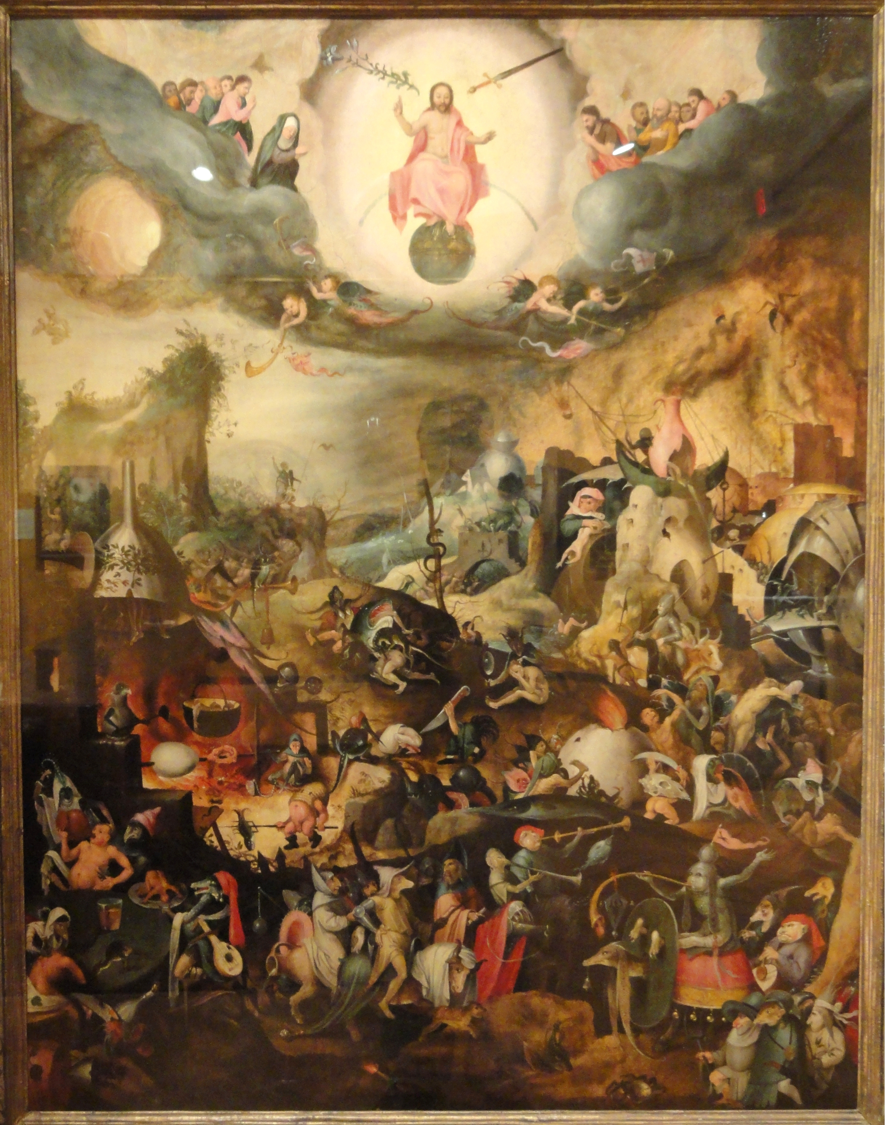
One of the benefits of studying apocryphal and pseudepigraphal literature is that such study alerts us to the intensely strange character of the religious matrix out of which our own tradition has arisen. This tradition usually appears to us as something familiar, well-known and well-worn; we think we understand everything, and particularly, we think we understand the structuring ethos, the whole frame. In reality, we have a set of blinders and presuppositions. We read our foundational texts and traditions through a lens provided us by centuries of mediators who have tamed and corralled the high strangeness, who have taken the sharp-edged stones and smoothed them and fitted them together to mortar up and close off the doorways leading off in the dark to places we can no longer imagine. Our texts and traditions do however contain these doorways. Sometimes we pass them by and see their outlines, now neatly filled with stones.
Fortunately we live in an era in which a vast panoply of ancient texts and a mass of scholarship on ancient religious belief and praxis allow us to knock some stones out of the ghost doors and shine a light into the passageways beyond, feel and scent the cool and ancient air moving as it arises out of the unknown depths.
In the New Testament we have a single document, the Apocalypse, which looms large in sectarian imagination, but we hardly grasp the extent to which it indicates the informing shape of the world from which our faith ultimately arose. There are traces of apocalyptic elsewhere in the Scriptures as well, of course; but underlying the canon we have is a host of other apocalyptic texts which were excluded from that canon and preserved only in untravelled and romantic corners of the ancient world. Oh, to live in the days when an advenurous scholar — an 18th century Indiana Jones — could find Ge’ez manuscripts of the Ascension of Isaiah in ancient Ethiopian monasteries! Only after this recovery was well underway did we begin to suspect that our own tradition’s account of itself was a mere sketch of reality, and a tendentious one at that. This realization was confirmed and solidified by the great textual discoveries of the 20th century — especially Qumran.
Ancient Hebrew religion as it actually existed was intensely rich and strange. The sketch we inherited as “history” from the polemicists of the ancient church presented this religion as a clean “monotheism,” in a projection of Rabbinic Judaism back onto Judaism’s origins. But this was a history written by the victors. In fact, the preponderance of evidence shows quite clearly now that “monotheism” is an anachronistic term. Even before Qumran and the translation of ancient pseudepigraphal literature preserved in odd corners and lost languages, there were already indications within the canonical New Testament of the presence of various streams of Hebrew religious tradition and praxis — “ghost doors,” as mentioned above, which one could comfortably pass by in the text only by failing to see them. These streams were in competition with one another and had been for centuries. Behind them all was the earliest epoch, during which “monotheism” was really rather a monolatry, a henotheism, or a so-called “kingship monotheism” as the operative cosmology. There was no absolute ontological distinction between the High God and the court of gods who surrounded him, merely a distinction of power and authority. “El” was the supreme god among a society of gods; and very likely, Yahweh was El’s firstborn son (Asherah was likely El’s consort, or one of his consorts).
A great deal that is perplexing in the Hebrew scriptures resolves itself when we take this view, and see the text we possess as bearing the traces of a long struggle between this more ancient view of the divine, and later views which moved towards a greater emphasis on the uniqueness of the Most High god amidst his court — of course, not merely a struggle between views, but a cultural and political struggle among the people who held those views, and who redacted and collated the extant canon according to their ideological intention. Rabbinic Judaism was the ultimate victor, but not until after the Roman destruction of the Temple. The Essenes, who maintained the ancient perspective (perhaps it could be said, the real “traditionalists” among the Jews in this regard), and out of whose milieu arose, most likely, both John the Baptist and Jesus himself, were forgotten, and it is only thanks to the curiosity of a lost goat wandering into a cave that we now have the ancient texts (the Dead Sea Scrolls) from which we can again hear their own beliefs in their own voices.
All of this is introductory to the point I want to make, and I will take it all as uncontested. The point that interests me is this: what we see when we press down into the roots of Hebrew religion is a vivid example of what Nikolai Berdyaev would call sociomorphism — that is, a religious belief that is a projection of human social structures onto the fabric of supernatural reality. (I am setting aside, for the moment, a real and deep theological question — namely, in which direction this projection is operative, that is, whether it is earth being projected onto the heavens, so to speak, or the heavens being projected onto the earth; this is a question of faith that reason cannot adjudicate. I will return to this question below.
What we see is a heaven that mirrors a reality on earth, and that reality on earth is the ancient despotism of the first Near Eastern kingdoms and empires. The various apocalyptic and visionary narratives that were the air breathed by the ancients who shaped our contemporary traditions at their roots depict a heavenly court whose structures and inhabitants mirror the palaces and courtiers of the political powers of their time and place. The glory, majesty, and mystery of these heavenly courts are redolent of the despotism, grandeur, and mystification that attended the earthly courts the authors knew. The protagonists of the old apocalyptic and visionary narratives advance through the palace-temple of the heavens, encountering a progressively awe-inspiring community of divine beings, entering progressively more rarefied holy spaces, being washed and anointed and clothed in a way appropriate to this advancement, facilitating their “ascension,” until they finally arrive at the throne room, the Holy of Holies, where El Elyon is seated in majesty in the presence of his sons (including, of course, his Son) and chief viziers, and fall prostrate in obeisance before him.
I do not love this literature, and you may already see why.
The vision of this divine court finally produces intense revulsion in me: God sitting on this throne like a king among his nobles, receiving obeisance and praise and worship: there is nothing instrinsically beautiful here. God’s glory is here depicted as that of an ancient oriental despot with his foot on the heads of his enemies and with his courtiers gathered around him; this whole psychedelic panoply of visionary despotism is repugnant. I say “psychedelic” because the aesthetic of these visions is clearly so to me; I have spent plenty of time in fairly intense psychedelic states (not part of my current spiritual diet, only a part of my past), and when I read these ancient visions of crystalline figures with hair white as snow, with blazing eyes and golden limbs, fearsome hallucinatory beasts, and so forth, I immediately think, “Whoever wrote this was on mushrooms” — or at least, was drawing on a psychedelic experience and interpreting it as somehow a revelation of a deeper and higher reality. Alongside these psychedelia there is also the taste of a deep, atavistic, animal fear: there is a cringing before an overpowering force the sheer strength of which is existentially crushing and annihilating. It is dangerous.
(I know, I know… “Aslan is not a tame lion.” Yet he never seems to eat his well-meaning children alive, either — so in fact, although he is in some sense the mysterium tremendum, he’s not as tremendum as all that in the end, is he?)
To some extent, those familiar with the ethos of this literature are accustomed to say that Christianity radically revised it — that the experience of “holiness” as a profoundly dangerous force was transformed in Christianity into a vision of gentleness, mercy, and moral beauty. Very well — but what of the Apocalypse, where all the old themes, where the entire ancient apocalyptic atmosphere, is an operative, if not decisive, influence? In this, we may sympathize with D.H. Lawrence’s assessment of this text as profoundly anti-Christian. We may also suspect that Christianity did not cleanly reject the sense of “holiness as force” as much as it adopted, in parallel and in profound tension, another vision of holiness more deeply aligned with its experience of Jesus.
I suspect that this vision of the terrifying psychedelic splendor of antique despotism is repugnant not only to me, but to most other moderns as well, who have however inchoately been reared in a culture steeped in the idea of the human person’s dignity and inducted into reflection on its mystery; if anything characterizes modernity tout court it is this “turn to the person,” reflected in modernity’s finest theology and philosophy. I suspect that the jarring contrast with the despotic ethos of the ancient apocalyptic that formed the generative matrix of Christianity is fundamentally and intuitively obvious, and has been a central driver of the decline of Christianity; the peoples of Christendom have been like children coming to adolescence who suddenly realize that beneath their parents’ explicitly stated values and counsels, their family’s life is shaped in addition by unspoken, dark dysfunctions that utterly contradict those values — and like any sane adolescent, their response is “get me out of this house.”
There is nothing intrinsically beautiful about the vision of God seated on a throne like a king among his nobles, receiving obeisance and worship and praise — an ancient oriental despot with his foot on the heads of his enemies as his courtiers gathered around him. Rather than the worship of beauty, the presentation of this vision as some decisive manifestation of glory insists on the worship and mystification of power and authority, of majesty, and ultimately, of fear. But I cannot recognize grandeur except in moral grandeur, and I cannot finally recognize beauty except in moral beauty. The authors of ancient apocalyptic expect me to be dazzled by the spectacle they portray, but spectacles are neither morally nor spiritually convincing. The image of deity as above all a supremely powerful force means absolutely nothing to me; indeed, it disgusts me. (This, by the way, of course, is the evil and falsehood inherent in the gnosticism of the theology underlying the Star Wars franchise, in which the worshipful source of human power is precisely a mere “force”— rather than a person — that has both light and dark “sides”; in other words, the root of cosmic life is morally ambivalent. This is Jung’s Answer to Job that caused his break with Victor White.)
Sometimes, this whole inheritance of Christianity just weighs on my heart. Why must I include this whole questionable patrimony in my religion? The figure of Jesus is at best nested within and garbed with, and at worst, thoroughly saturated with and transformed by, this repugnant atmosphere.
This dazzling, apotheosized royal court that graciously welcomes a few cringing mortals whose purity must be achieved by ritual washings and anointings and prostrations — what does this have to do with the beauty of the earth that I actually inhabit?
Where’s the mud? Where are the fallen leaves? Where are the ordinary stones that don’t flash like fire? Where’s the gentle breath of wind, the scent of pine and sage, where are the trembling leaves? Where are the coyotes, where are the crows, where are the squirrels, where are the frogs, where are the cicadas? Where’s the dappled mountain I study from across the canyon, come to life again after the fires, which has never known the obsessive regularity praised by geometers? Where is the wu-wei? And most importantly — where is Jesus?
Above, I mentioned “a real and deep theological question — namely, in which direction this projection is operative, that is, whether it is earth being projected onto the heavens, so to speak, or the heavens being projected onto the earth… a question of faith that reason cannot adjudicate.”
To me it is clear that the ancient apocalyptic from which our faith was formed is the former: it is the earth being projected onto the heavens; it is Berdyaev’s sociomorphism; it is an existential attempt to grapple with the terror and powerlessness of human existence by rooting our abasement in the nature of God and his cosmos, by somehow making it ontologically just. But it is equally clear to me that when this movement is reversed — when it is not a cringing mortal seeking admittance to the overwhelming glory of the divine precincts, but a divine figure descending to Earth, Christianity presents something starkly and radically different. Everything is turned upside down. All our expectations and imaginations about the character of God that are reflected in apocalyptic literature are shown to be profoundly mistaken.
Where apocalyptic discloses the heavens through narratives of human ascent and descriptions of what the glorified seers experience, Christianity’s originating myth presents instead a narrative of descent: it shows us not a man elevated to the presence of God, but a god descending to the intimate presence of human beings. And in this descent, as Christianity presents it, what do we see? Do we see God as a king? Do we see him as mighty? Does he offer the instruction in ritual washings and oblations and gestures of obeisance? What happens to his glory?
Tradition says, “It is veiled, and it will be revealed again.” But what if the coming of God among men is not a veiling, but precisely a revelation, an unveiling, a true apocalypse? Study the Sermon on the Mount and its promises; study Jesus’ heart for the poor, for the little ones, for children, for the widow and her mite, for prostitutes and tax collectors and sinners, for heretics, for the dregs and wrack of human society, for the lilies and the birds. Study his hidden life as a carpenter’s son, a manual laborer among peasants. Study his life as a man condemned to an unjust death, as a leader whose followers abandoned him.
What if the whole apocalyptic literature and its valorization of power and glory is a mistake, and the entire life of Jesus is a correction and a rebuke which the ekklesia received, but has struggled for 2,000 years to metabolize?
Jesus saith unto him, Have I been so long time with you, and yet hast thou not known me, Philip? he that hath seen me hath seen the Father; and how sayest thou then, Show us the Father?
If this is true, then the way to the vision of the Father is the vision of Jesus on earth, and all the references to glory — even O Father, glorify thou me with thine own self with the glory which I had with thee before the world was — are to a glory that human beings disfigure and obscure when they read it as a glory like that of the despots who rule them through majesty and terror and demand their obeisance. The Sermon on the Mount is then an existential and cosmological coda to all the old visions of the divine court; when the Son of God comes, he does not say, “Blessed are the kings,” he says, “Blessed are the poor.”
Humanity spent millennia dreaming about holiness as the power of God, and God came to reveal holiness present in the very life from which their dreams had turned. God really is “king” — but until the advent of the Son of God we didn’t understand what kingship meant, we didn’t understand what glory meant. He opens the humility of created things to reveal the glory that dwells within humility — in place of the thunders of many waters, God is quiet; God’s glory is quiet. Glory as gentleness, dwelling with the anawim.
It is like the dew of Aermon, which cometh down upon the mountains of Sion. For there the Lord commanded the blessing, life for evermore.
(to be continued)
I simply don’t feel the tension or contradiction you do as I meditate on and read the scriptures. It feels like a unified whole to me. God as a consuming fire, the terror of the Lord, Abba, Father, come unto me and I will give you rest, lead to living waters, a sword to strike down the nations, wipe away every tear. Maybe because I experienced strong , loving parents with authority to punish, the queen and king of the household high standards and responsible caring and provision and a love not based on your performance who were not hypocrites and at the same time merely human, humble and approachable.
I share your revulsion for this imagery, especially as someone who is largely quite new to the Faith. It has been difficult to take it on, having grown up with the modern and quite justified aversion to such notions of authority and power.
Yet within the practicalities of imaginative prayer, I have found that there is no better vision to communicate the virtue of humility. To bow my heart, mind and will totally and trust fully to the One and Only.
Due to this I am not sure if we can necessarily disband it. It is discomforting for the modern sensibility yet we have no other adequate imagery within the modern sensibility to replace it in my opinion. We cannot sociomorphically project God and the Heavens as Prime Minister or President and His Divine Parliament or Congress. It doesn't work quite the same as a means to communicate what I have spoken of.
We live in a world where such royal and courtly imagery doesn't have as much salience for us, that causes in us an alienation and a scrupulous sense of unworthiness if anything. But because of this, such imagery can be now used for its proper purpose, instead of justifying human power politics, it can be used to deepen in us a deeper knowledge of what humility involves (via a sort of analogical imagination).
And this can be also found in what I think you are pointing to, of finding God as Patrick Kavanagh says, "in the bits and pieces of the day". We can find in His work as carpenter, carefully and lovingly carving and hammering our world and our souls. And in the same way we would thank and praise the skill, wisdom and authority, a carpenter had in crafting us a beautiful table, we should thank Christ.
(None of this is a critique by the way, tell me if I am missing something or if I'm drivelling buckets)
So in a very long winded and loaded fashion this leads me to ask: what and where do you find God's simultaneous majesty and tenderness? Or what better human roles than king and court may we sociomorphically project to God and the Heavens to induce in us a more healthy and fulfilling relationship with God and the Heavens, leading to a more increasing love within the soul?
Maybe bridal mysticism has this covered for us, who knows.