
With Freshness and Joy
Some Notes on Getting Old

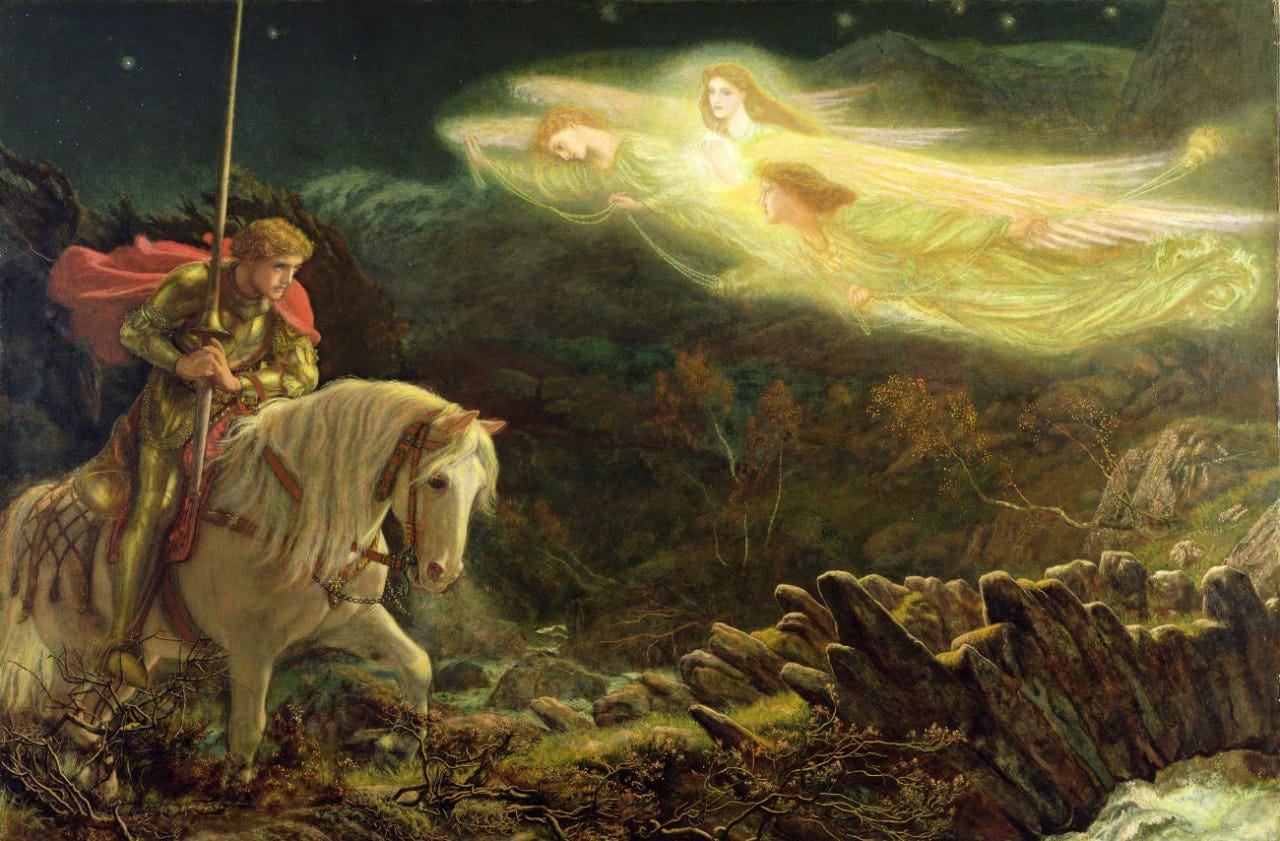
Recently, I made the observation that part of the invitation of aging — and I really feel this existentially — is that what we once had as a vitality that is natural to us, that we had whether we willed it or not, was simply grace and gift. I’m thinking of the enthusiasm and the vitality and the curiosity and the delight and the zest of childhood, but particularly of youth; in a way, youth is childhood plus sexual awakening, where the magic of childhood is raised to an even greater pitch by the erotic engagement with others and with the world that is invited by the blossoming of our sexuality.
In all of that, there’s a vitality that is just bestowed upon us, it’s just poured down on us, at least when we’re not suffering from some debility or illness. And then in the course of life, that fades, for various reasons. It fades because “life happens” to us and poses questions to us: through all the various forms of death, suffering, adversity, and misfortune.
While that impulsive energy is still natively and naturally strong, and not challenged on a fundamental and existential level, we’re largely oblivious to our possession of it (hence the saying “youth is wated on the young”). We have struggles of various kinds, of course, but in retrospect we can see that we were plowing through them with a kind of thoughtless, unreflective abandon — as is appropriate for that kind of energy.
Simply biologically, there’s a waning of that impulsive energy. The waning of that biological exuberance, the cooling of the natural fire, is at its root an invitation for us to create that fire again, to kindle it within ourselves as a matter of consciousness and intention and personal, that is free, discovery, motivated by an impulse that we evoke within ourselves as a genuinely creative effort.
There is a genuinely agonic dimension to that effort. Because the discovery of it is such a stretching out, it’s a profound exertion, an athletic exertion of body and soul. It requires first of all a wise stewardship and askesis with regard to the body, aimed not towards mortification of the body but towards its vivification.
(Truly, I hate this term, “mortification.” No: vivification, to make the body a vital participant and colleague and servant of the whole living person.)
Along with that bodily askesis, there’s a spiritual reaching out, a spiritual “athletic endeavor,” as well. In youth, there is an innate faith, an innate joyful ambient perception of the richness of the world and the richness of life, of the inexhaustible character of life and the inexhaustible character of the world — there’s a promise sensed and believed in a visceral, bodily way. So in every exploration that we make, in every enticement or invitation that’s posed to us by a mystery that we perceive in the world, there’s the sense, the promise — agonizing though it may be in its own way! — that marvels await us around the next corner.
I always used to have this sense, particularly in religious exploration — when I would march into some house of worship of some religious community with the sense that the truth might very well be there waiting for me to discover it. Some glorious understanding might be awaiting me. In this tension of the soul, each next step is a step that might show me this glorious understanding.
I think this feeling is native and natural to youth, innate, or to say differently what is I think the same thing, a matter of grace. As we age, that grace withdraws, and we’re left needing to discover and evoke and claim it in our freedom. “In our freedom” means in our podvig, in our effort.
What is the taste of this podvig? It’s a decision not to close oneself. It’s a decision not to close the heart. It’s a decision not to think that everything is done, but to remain in motion.
Although I’m approaching 60 now, I am told by many people that I look much younger than I am. And I’m told by people who don’t see me but interact with me online that they’re surprised at my age — that my writing projects a more youthful persona than they would suspect. I haven’t inquired with them what it is about my writing that suggests this, but the orientation underlying it, I can say honestly, is both wonderful and disturbing to me.
It’s disturbing because I always feel myself to be somewhat unsettled. I always feel myself to be longing, to be reaching out for something deeper. I’m always finding something in my worldview, in my spiritual praxis, in the existential orientation of my heart, that is unsatisfying, that isn’t deep enough, that isn’t high enough. And I’m casting about with a genuinely open mind and heart saying, where might I find that deeper thing? Where might I find that higher thing?
As a result, I’m attending to things, both intellectually and spiritually. I’m attending to things with a genuinely open and exploratory frame of mind and heart and soul to inquire about what is present there.
Beneath all this, I feel myself like an animal on the scent of something. I use the word “scent” deliberately, because the sense of smell is perhaps our sensual window that is least amenable to rationalization, the least amenable to reduction to a scheme of ideas or to a rigid structure of praxis that correlates with some rigid structure of ideas, and perhaps is built up from it. There is something coherent underneath the activity of my attentiveness, there is a “something for which I am searching,” but it’s not something that I can easily (or perhaps at all) describe in words.
It’s something that is evoked in me by a feeling for things. And so, it’s troubling, because I always feel myself — wherever I am — in a kind of instability. I’m reminded of a lovely saying by Metropolitan Anthony (Bloom) of blessed memory, that Russians are people who always seem to be camping out inside their own homes: that even at home, they are constitutional wayfarers. In a way, I feel myself to be camping out inside my own life. I have a resonance with the Russian palomniki and stranniki, the pilgrims, the wanderers. Deep within, they are carrying something rationally unknown to them — something that harmonizes, that vibrates as they go, like inner dowsing rods.
I also have that inner dowsing rod. And of course, there are all the vicissitudes of the journey — errors and missteps and mistakes and delusions and all the rest. This is the pilgrim’s agony. But the pilgrim’s glory is that he is alive.
I used to beat myself up for this and wonder “Why can’t I just be more stable? Why can’t I be more permanent, as I see other people being? They find something, they find a way of life, they find a aesthetic, they find something that’s very definable and they settle down, they adopt it; they settle down into it and they live out their lives in it.” And I’ve beaten myself up saying, “Well why can’t I do that? What’s wrong with me?”
But as I’ve gotten older, I’ve begun to be very grateful for my questing soul — because I have through this retained what seems to me to be a youthful openness. Of course it’s me, so I would think this, of course — but it’s desirable, a desirable way to be: perhaps one desirable way to be of many such ways in the world.
This I think is what I’m referring to when I say that “growing old is not for sissies”: on autopilot, while theoretically it’s possible for someone who has settled into a praxis, into a belief, and into a way of life, might continue to grow in it. But to do that, they need the salt of this lesson — that you have to be on the scent of something deeper in that tradition. You can’t just stay put at the same level that you’ve already achieved. You’re not going to go higher or deeper in that settled thing that you have chosen for yourself unless you have a sense of hunger, unless you have a sense that your experience, understanding, and grasp of that settled thing is not yet adequate.
You have to learn more. You have to go deeper into it. You have to discover new depths in it. And sometimes those new depths are going to be so surprising that they actually amount to a revolution. Even within the framework which you have acceptd and in which you live, when you are truly on the quest to go deeper, when you are truly climbing the mountain to go higher, you have to retain a fundamental openness. You have to be willing to have your entire vision of your life be transformed by a new and deepening insight or a change of perspective. You have to be willing to change.
Life is change. All metaphysical speculations aside, the objective reality of which I’m actually aware is that life is change. Life is metabolism. Life is growth. Life is movement. And I think one of the great harms of a philosophy of stasis, which is what a lot of the perennial/Vedantic/Platonic stream lives in, is basically an apotheosis of stasis.
Figures like St. Gregory of Nyssa — perhaps himself an exemplar of the attitude I am commending! — try to remain within that framework and yet rise above it, try to break it and expand it: in his case with the notion of epektasis, a perpetual reaching-out, inspired by St. Paul (“Forgetting those things which are behind, and reaching forth unto those things which are before, I press toward the mark for the prize of the high calling of God in Christ Jesus”). Not to say that my feeling is a “Pauline feeling,” but it’s a feeling that Paul and I obviously share, and that St. Gregory is trying to adapt into his Platonizing theology.
One of the great harms wrought by the theology and metaphysics of stasis is that it removes life. It tries to work its way around this with all kinds of conceptual sleight of hand, and to me, bluntly, they don’t succeed. The radical critiques, the critique of all kinds of process-relational philosophy and theology, which I think are much more fundamentally consonant with genuine theistic worldviews, are trying to address the fact that stasis is death.
Death is stasis. Life is movement. This, it seems to me, is just unarguable: to claim otherwise is sophistry and foolishness and flies in the face of our most immediate experience, the only experience out of which we can possibly construct any systematic thinking at all. The experience from out of which we reflect on anything is the experience of life. Every act of reflection, everything, our whole living presence as beings engaging with and wrestling with spiritual and material reality (if those are finally distinct; I don’t think they are), necessitates this sense that life is movement and change.
And so the movement and change that impel us in our youth and our childhood are graces that are given to us, a waybread to introduce us to this reality, but they’re graces that are providentially withdrawn from us as we age. The world and its free development has produced this reality of aging and the decline of this innate vitality, and God has providentially turned that to His loving purpose (as He does everything): this purpose being the elevation of our souls and bodies to new, more expansive, deeper, more intense forms of life. The withdrawal of grace is then a gift and an invitation to us to pursue that grace in freedom and to reach down into ourselves and discover the hunger for that grace in freedom, and to strive for it.
Now, what does that striving mean? Here we get more into the realm of poetry and romance. It means to wake up every morning like a pilgrim at his campsite, ready to move on to the next stage of the adventure. It means genuinely, romantically, to be a knight-errant on a quest, on a vast, impossible quest, like a hero in a fairy tale who has been given a task by the king. If he wants to marry the king’s daughter, he has to accomplish this impossible task — this absurd, impossible task. But the key to the achievement and the key to that impossible task might be the thing that you meet today. It might come today. This to me is a much more heroic and romantic vision of what nepsis means. Nepsis as “wakefulness,” in the language of classical Christian asceticism.
On the path of this life’s quest, wakefulness means attentiveness to the clue, to the vital treasure that unlocks a secret, that gives victory in a test. Because throughout the corpus of traditional fairy tales, there are clues that come that have to be treasured in the hero’s heart in order for him later to unlock some door that proves the significant key to the success of his quest. This is the youthful attitude, this alertness, this vivacity of the sensitive and sensual and erotic intelligence.
By the nature of the case, by the nature of this earthly probation, we, as far as I can see, do not generally meet with the culmination of our quests in this life as it now is. So we’re a knight who ages on the quest. And do we remain faithful to the quest in spite of the fact that we’re aging? And do we find within ourselves the strength, the inward strength, the inward longing to remain faithful to the quest, and to remain watchful, and not to lose heart, and not to lose hope that the key to unlock our triumph in this quest might be something that we encounter today in a person, in a vision, in an inspiration, in an idea, in an event, in a learning.
It might be today. We need to feed the fire of that sense that our quest is still ongoing, and the object of the quest is still supremely desirable, however tired we may be, however far we’ve travelled. I think of the prince in Rapunzel, wandering blind in the wilderness until that blessed day when he hears Rapunzel’s voice and runs towards her to have his eyes wetted and healed by her tears. How does he recognize that voice? Because through all the years of his wandering, he has treasured it and kept it alive in his heart.
You also have a voice that you must treasure and keep alive in your heart.
Whatever our level of exhaustion, whatever the weariness and trouble of life, our faithfulness is now what evokes grace. What was given to us as a gift, as an earnest towards our future glory, is now to be given to us as the fruit of our faithfulness. All of that is simply an invitation to do all things to keep that fire alive in our hearts with freshness and joy.
I wrote all this and I meant all this. This is not AI schlock.
I think you're a poet who got sidetracked into theology. Or perhaps I simply think this of myself and project it on to you as well. The poet lives within the depths of appearances, of feeling, of vision — within the being that manifests as becoming. The theologian is too often tempted to 'look behind the curtain' at reality and 'tell the actual story' in the language of reason. But it is really other other way around. The poet tells the greatest truth by attending to the play of reality manifest in the world of becoming; and the rational account, while not nothing, is perhaps an evasion of our true creative role.
I say all this in reference to the restlessness you write of in your essay.
Stunning. I need to read this again and again (and again). I don't know why, but I have this impulse to put vitality in conversation with Paul's metron pisteōs. Also, I think you have a book inside of you!