
Sister Death and the Hermeneutic of Suspicion

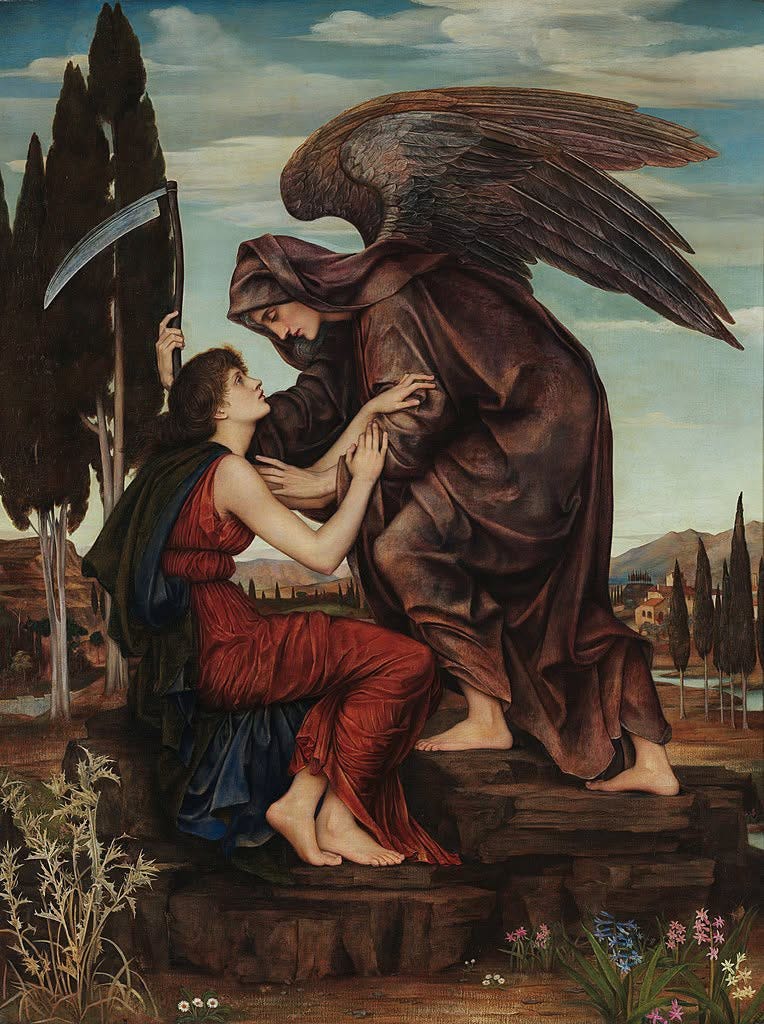
When I recently got a copy of Gustave Thibon’s book What Ails Mankind? I turned immediately to the few pages that the table of contents suggested would be an attack on personalism. I like to start with the stuff I think I’m going to disagree with. I’m not sure that I’ve made it clear in my longer-form writing, but personalism has long been at the core of my faith and life. I became Orthodox in part through reading Nikolai Berdyaev, whose philosophy is on fire with personalist conviction, with the sense of the incomparable worth and ontological significance of the person and of freedom. He’s almost fiercely intoxicated with the sense of this worth and significance, to the point that he’ll make bold statements that person and freedom are more fundamental than being. Yes, to the more sober and rational, these claims make no sense. But my heart says “yes” to them and for better or for worse, this was the school in which my heart was taught. This kind of Christian existentialism and personalism is in some way my unarguable bedrock. When I look into the eyes of someone I love, I see what is more valuable than heaven and earth. Hier stehe Ich, le cœur a ses raisons que la raison ne connaît point, etc.
But Thibon makes a point that gives me pause. He says that one of the things ailing mankind is this exact insistence on the person’s primacy; he was, I suspect, irritated by the “turn to the person” that was overtaking Catholic theology during the Ressourcement. He says in a nutshell that this monomania for the person has led to a situation where institutions have no weight any longer, and thus are dissolving. Where someone might once have had respect for the institution of marriage in spite of the disreputable or dissolute character of a married person, or for the institution of monarchy in spite of the deceitfulness or corruption of a monarch, now that bulwark of stability is gone, and “mere anarchy” is increasingly the result.
I have personalist answers to this critique, of course, but it awoke something in me. Personalism construed as an affair of human persons alone — or perhaps of human persons and God, maybe with a smattering of angels — may have intensified modernity’s dismissal of what I could call “religious hypostatization” — the feeling for non-human and yet non-divine persons. In other musings on re-enchantment I have suggested that Christians need to regain their sense of inhabiting an animist cosmos, that is, they need to extend their personalism to nature and to the subtle inhabitants of nature — I do not say “disembodied,” but perhaps differently bodied or subtly bodied co-inhabitants of our world. Really-existing Christianity of course has acknowledged these beings and the importance of good relations with them for as long as Christianity has existed. There is no particular reason to deny their existence except from a commitment to reductive scientism, and I take it as settled, among my sympathetic readers anyway, that reductive scientism is a Procrustean bed for the human soul. “First they came for the sylphs and dryads and naiads, then they came for the angels, then they came for God, and now they’ve come for me” — pretty much a summary of modernity and the advance of its ruinous monism as a kind of metaphysical Sherman’s March.
Very well, then: but perhaps more beings also deserve a place in the expanded universe of a more-than-human personalism. The Roman state cult included so many of them: Liberty, Victory, Harmony, Hope, Piety, Clemency, Honor, Justice… these are only examples. What I am feeling, to say it again, is that a possible avenue of escape from the poverty of a “mere” personalism is to expand it to other numinous beings, the personal existences and personal radiances of the divine ideas.
Of course, this goes without saying: it is one thing to make the metaphysical and existential move of acknowledging that these beings are real. It is obvious to me that they are — they are real and human beings orient their lives to them, indeed, they worship them. This is where a fundamental Christian poetry must intervene: before a Christian can venerate these beings, they must become worthy of veneration, that is to say, they must be converted to Christ.
Does the Lord tell us before the Ascension to “preach the Gospel to all creatures”? Well then, we have to preach the Gospel to these old gods and goddesses and daemons and elementals — and not only must we preach it, we must preach it successfully, we must actually convert them. Then they become our brothers and sisters, rather than our masters. You can read me metaphorically here: this is a creative work of Christian culture — but I will be bold! I will say it is the creative work of Christian culture, and it is one that we have fled, by and large, at least as far as the formal church is concerned. (Some Christian communities have borne more fruit than others in this regard.)
So let me take this to the place where it really struck my soul and gave me something new.
I recently read the following meditation by the Irish Catholic priest and theologian Noel Dermot O’Donoghue (a man whose books on Celtic Christianity will repay your attention):
Pain, and its sisters, loneliness, fear, death and the rest, are the constant companions of man's day, of each man and of all men. They are our dark companions. Not evil companions (as are, say, bitterness and pride) but good companions who are dark and strange. They walk on man's left, as joy and freedom and peace walk on his right. They call out to us to be accepted, for each somehow belongs with us. They call out, and when we say 'yes' they are in a way companionable. We even wonder whether they may not be, after all, friends along life's way. We can look each in the face, but each retains its mystery as we gaze, and will not be bound within the narrow limits of a logos of the pysche, or of the mind's wisdom, or of the source of man's being: neither psychologist, nor philosopher nor theologian can catch any one of these companions in his net. So if we together look at the face of pain we must accept that it is in Levinas's term le visage de l‘Autre: the countenance that insists forever on its otherness and infinity.
[“The Dark Ikon.” The Furrow 31, no. 12 (December 1980)]
“Good companions who are dark and strange.”
Could it be that Pain and Loneliness and Death have been converted to Christianity?
Reading Fr Noel in the context of this wider thought of the extension of personalism to a whole vast panoply of subtle beings — an expanded universe of personalism — all of a sudden, I felt St Francis’ “Sister Death” for the first time, I felt her as a “good companion who [is] dark and strange,” as an other who is my companion, with whom I share this earth and this life, and from whom I have incomparable gifts to receive — and stranger still, perhaps she too has something to learn from me.
Perhaps I will be instrumental in her conversion to Christ; perhaps in some way, each of us in personal relationship with these “dark and strange companions” is always about that work, bringing them to God’s service. As they’re converted, their strangeness and darkness loses its moral ambivalence. Perhaps it’s then merely a necessary character, a gravitas, that they have for the role that they will now providentially fulfill.
When I think about what that role might be, in this perspective, my heart opens beyond the utter rejection of death that has so shaped me spiritually — death felt as an affront to personal being, as the final loss against which I rise with a Promethan No! I think: what is the positive character of death, no longer the “grim reaper,” no longer the substanceless, impersonal skeleton with a scythe, but instead this pale, quiet, gentle, earnest traveller keeping pace tirelessly at my left hand on this journey of life?
What does she speak to me about? Detachment. High moral earnestness. Moral sifting and evaluation. Piercing clarification of values. Straitening, chastening, purifying. Her fearfulness is somehow then necessary, it is part of her providential mission to me.
This reflection illustrates where grasping things requires so much more than ideas and words. An entire shift of existential orientation may have begun when this thought or observation or proposition of Fr Noel happened to find me in the particular inward state in which I was, the total circumstance of heart and mind and life. The realization, the new perspective, couldn’t have come about merely by words or by argument. It had to come about through this total context of life experience and feeling. That points me to a kind of deep humility, both in terms of my own pursuit of knowledge and in terms of my attempts to convey whatever knowledge I have to someone else. There is so much more than words.
So, a last thought.
The “hermeneutic of suspicion” — that approach to texts and teachings and thoughts that always starts by trying to find subterranean motives and distortions, basically the interpretive approach into which the academy will now indoctrinate you if you allow it to — only applies when you don’t know that someone is sincere, that someone means you well. The hermeneutic of suspicion can only apply to a communication that is effectively anonymous, which can be the case even if you know something about the author — unless, that is, you have a heart sense that he’s sincere and well-meaning in the most fundamental way, that his heart is good. When you have that, then you have no need for the hermeneutic of suspicion.
Reading Fr Noel’s reflections, I had the beginning of a transformation of my feeling around the notion of Sister Death, the notion of death as a strange and dark companion on the journey of life, but not an evil one. The hermeneutic of suspicion responded, “Oh, but you know — is that just the dark death-loving corruption of Christianity worming its way in, giving you something emotioanlly and rationally convincing to snare you?” And my immediate heartfelt response to that is, “No, I know this man. That’s not the case. That’s not what is happening here.”
And interesting, how do I know this man? I’ve read two or three of his books and some of his articles — that’s not much, but somehow I do know him. And in that way, I trust him. This is the kind of trust that we have to have in a tradition, in the bearers of a tradition. And we can’t manufacture that trust willfully; we can’t simply will to have that trust. We can only discover that we have it. Maybe that’s the sense in which faith is a gift, and not something that we acquire by our own effort — a grace and a gift.
AI Statement: I am a flesh-and-blood human being; I wrote every word of this myself and I meant all of it.
I offer my paid subscribers personal correspondence on the spiritual life by snail mail. If my writing resonates with you and you would benefit from this kind of conversation, you can subscribe below.
What stayed with me is the movement from resisting death as the final violation of the person to encountering it as a dark companion whose presence clarifies what matters.
Perhaps some truths cannot be accepted through argument because they must first become relational. We do not merely understand them. We learn to stand beside them.