

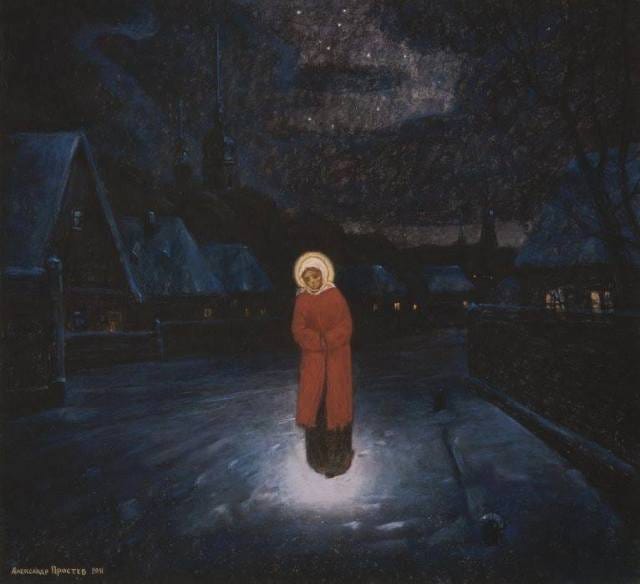
It may not be obvious to many of my readers that I’m an Orthodox Christian, and those who know may wonder why I’m still an Orthodox Christian. In these cris de coeur I have said bluntly that I am not sure I believe the Nicene Creed as a set of metaphysical propositions; that the traditional asceticism counseled by the Church as the bedrock of spiritual life is repugnant to me; that I am seeking some way to re-inhabit the animist cosmos of my pagan ancestors; that I am a radical ecumenist skeptical of evangelism as a call to abandon non-Orthodox or non-Christian spiritual patrimonies; and that I have an acid disdain for Orthodox rigorists and polemicists. I have waxed lyrical about visions of Aphrodite and questioned the absolute normativity of the Church’s teachings on human sexuality. I write regularly and appreciatively about theologians and philosophers not just beyond my own tradition but far beyond it; I listen to them earnestly. So what am I doing still in the communion of the Orthodox Church?
The first simple answer is “Jesus.” Jesus has so far survived all of my honesty and all of my questioning. Jesus has persisted in reminding me that there is a holy of holies within the faith, interior to all the superstructure of dogma and praxis built up over the centuries. I have never visited Jerusalem, but I have the impression of the holy sites of Christian history and imagination there as archetypes of organic growth: shrines built on shrines built on ruined shrines; contentious hierophants on the same holy ground in an uneasy peace that occasionally breaks out into a brawl (a description that could serve as a summary of exoteric Christian history); labyrinthine streets and passages and walls and tunnels leading, by paths traveled only in trust of the pilgrims who have gone before, to the earth heart tomb-cave of the Resurrection. All are accidents of history pointing somehow, impossibly, to the essential that is not an accident. What is true of human history, with all its sin and error, is true of the Church, with all its sin and error.
And so it is all bound together: the beautiful agony of the wrack and ruin of human and cosmic history; the witch-light of the moth-like stars that I follow through hollow lands and hilly lands; and this Jesus, merciful and ruthless teacher, faithful companion and lone-wolf cosmic troubadour; water-walker, water-giver, wine-maker, storm-calmer, Spirit-breather; judge, redeemer, crucified, risen; who transfixes my heart and my imagination, before whom I kneel and say de profundis, as in that moment my mind bows down with me, “My Lord and my God.”
Wisdom is youth that has met the tragedy of life. Fortunate as I am, I know little enough of tragedy, and thus unfortunately, I have little enough of wisdom; but my own drop of tragedy is enough for me to taste the ocean of it. My youthful innocence and joy are an Eden from which I am blocked by an angel with a flaming sword.
But what does the wisdom gained say? She tells me what is most precious: living souls, the bodied persons who surround me; beauty, aesthetic and moral and sensual, the desire of it and the pursuit of it and the veneration of it and the service of it; and freedom — all terrible brightnesses but in that very blinding excess, undeniable, even as all lie under the sign of death. And so the other precious gift or curse — heartbreaking, unbearable — is the cry of desolation from the cross of crucified humanity. Where else but in the story of Jesus is all of this presented to me as the model and matrix, where else is it all laid before me with the exhortation to choose life? The story is incomparable; everything is here.
And what, then, does wisdom counsel me to do? To give my heart to serve what is most precious, to shed blood in the hope of receiving the Spirit, to wait without idols, as Auden says. This is not a rational enterprise. This is not a rule of life. This is neither a goal nor an objective. If there is obedience in it, the obedience — the “listening,” the “hearkening,” etymologically — is finally to the Lord, but to the Lord whose voice I find to be, when I listen deeply enough, the very voice of my own heart. Deep calleth unto deep at the voice of Thy cataracts.
Yes, then, Jesus: but why Orthodox Christianity?
The “blinding excesses” of God’s wisdom, in God’s wisdom (as faith might testify), “all lie under the sign of death.” St John’s Gospel says it in the prologue: τὸ φῶς ἐν τῇ σκοτίᾳ φαίνει, καὶ ἡ σκοτία αὐτὸ οὐ κατέλαβεν. “The light shines in the darkness, and the darkness has never mastered it.” The verse is ambivalent. Are we to rejoice that the light remains shining — or are we to lament that though it endures and shines, it has not dispelled the darkness?
What, indeed, is the tenor of our whole life as our hearts bow before the Lord? Is it joy, or is it lamentation? Is it ecstasy, or is it repentance? Is Christian life a feast or a fast, askesis or eucharistia? Should we, may we, can we “be of good cheer” in the face of a world that gathers in a mob around Jesus and shouts, “Crucify him, crucify him”? Because after all, he is crucified every day, to this day.
This drama is not located comfortably outside of me, situated for leisurely, detached contemplation — it is a drama that unfolds within me, where I know within myself both the light that cannot be extinguished and the darkness it cannot dispel. I know it both in my failure and in my doubt, and it haunts me in the midst of my joy. I know it in my inability to reconcile belief and unbelief: a belief, or perhaps a hunger for belief, that will not die, and an unbelief that will not let belief live. O Lord, I believe; help thou my unbelief!
This is small-c catholic Christianity, κατά ὅλου, “according to the whole.” Fundamentally it is the Christianity that lives within the tension of light and darkness, knowledge and ignorance, sin and virtue, failure and victory, earth and heaven — as we also live in this tension, we in whom prayer and the life that is prayer become, as a consequence, drops of blood, as they did for the Lord in Gethsemane. The Didache, the oldest record of Christian discipline outside the New Testament, instructs us to pray the Lord’s Prayer three times daily, in which we educate and concentrate our hearts to feel and to say, “Thy will be done on earth as it is in heaven.” It is a petition, the summit of all petitions — not a proclamation, not a metaphysical proposition.
This is therefore the life of the Church. The impulse for that life to be “pure,” to be “according to our thought,” κατά διανοίας, rather than “according to the whole,” κατά ὅλου, is an impulse to escape Gethsemane and Golgotha, it is an impulse to refuse the cup that the Lord — showing us, opening to us, our way — accepted. The Church is not pure, not infallible, not merely divine. The Church is the heart of each of us writ large across the ambivalence of history, sketched in chiaroscuro. Here, without seeking to impose my mind on it, I find that surely the Lord is in this place; and I knew it not.
Above all, I have found the Orthodox Church to be the ecclesial body where this truth is accepted and lived with the fewest institutional and doctrinal scars of rebellion. If the Orthodox Church is a garden, we are the gardeners who have learned best from Masanobu Fukuoka, the Japanese apostle of “do-nothing farming,” agricultural wu wei. We have let it be messy, as it wishes to be. We have both ferociously defined it, and defined that it cannot be defined. We have insisted on hierarchical strictness, and undercut the hierarchy with the illimitably hospitable expanse of oikonomia, “household management.” We have established rigorous structures to administer the Mysteries, and accorded quiet finality to the witness and judgment of charismatic elders and fools.
This is why it is so superficially fruitless and infuriating when we participate in ecumenical dialogue. The self-selected cadre of polemicists can only ever represent one shade of the chiaroscuro, and it’s one we permit to exist, as we permit all the shades to exist.
This is also why visitors and enquirers and transient converts can leave, exasperated by some strand of aesthetics, or theology, or praxis that they find unsatisfying and problematic. Yes, those strands are there, they are like weeds, but we welcome the weeds. Our garden is supremely unkempt. But you should really stay long enough to taste the wine. If you fall asleep beside the fire in our temple that is open to the sky, it may be an uncomfortable night. But when you wake with an aching back, and turn over to look up, you might see a shooting star reflected in the dark waters of your heart, and your life will never be the same.
I thought about going Orthodox a while ago, but then I saw all the young men turning Orthobro and heading thataway, so my fad alarm went off, and I . . . decided not to, as per my contrarian custom. So I remain an Eastern Catholic, although these days I congregate with old-school Anglicans—or, as I think of them, the Northern Catholic Rite. I guess I like being Rome-adjacent but not Roman. The Romans don't reliably share the wine, which bothers me a lot as a poetic matter.
Thanks for this. I haven't had many second thoughts since entering the Orthodox Church 23 years ago, but I think it helped that my journey into Orthodoxy was slow (13 years before my chrismation). I also knew something of the messiness and diverse characters in the global Orthodox family, and the good and holy things God has given to non-Orthodox people. My late mom (baptized Orthodox and later as a Baptist, and married to a Lutheran pastor for 66 years) said it was only Christ who kept her in the church. Jesus Christ, the celebration of His Pascha with His Mother and all the Saints, and their recognition of His image in every human being, keep me in the Orthodox Church.